en
en
 عربى
عربى

Content
- 1 Can a Fire Truck Hose Kill You? The Real Physics
- 2 Fire Hose vs Fire Hose Reel: They Are Not the Same Thing
- 3 Can You Use a Fire Hose for Cleaning?
- 4 Types of Fire Hose and What Each Is Designed For
- 5 Fire Hose Pressure and Human Safety: A Practical Reference
- 6 Safety Rules Everyone Near a Fire Hose Should Know
- 7 More Questions About Fire Hoses Answered
Can a Fire Truck Hose Kill You? The Real Physics
The answer is unambiguous: yes, under the right conditions, a fire truck hose can kill a person. This is not hypothetical — there are documented cases of civilian and firefighter fatalities and severe injuries caused by uncontrolled hose lines. Understanding why requires looking at the numbers behind the water.
At 150 PSI, the water exiting a standard 2.5-inch fire hose nozzle carries kinetic energy roughly equivalent to being struck by a moving vehicle at low speed. A solid stream at this pressure aimed at an unprotected person can:
Crowd Control Use: The Controversy and the Evidence
Fire hoses were historically used for crowd dispersal — most infamously during the 1963 Birmingham civil rights protests in the United States, where hoses set to 100 PSI stripped bark from trees and tore clothing from people. Modern human rights standards widely prohibit the use of fire hoses as crowd control tools. The UN Basic Principles on the Use of Force by Law Enforcement Agencies addresses water cannons (which operate on similar principles) as a use-of-force escalation requiring specific justification.
Water cannon vehicles used in riot control typically operate at 40–80 PSI — significantly lower than a fire truck's attack mode — yet still cause eye injuries, bruising, and in documented cases, fatalities when people fall and strike hard surfaces. A full-pressure fire truck hose is categorically more dangerous.
Fire Hose vs Fire Hose Reel: They Are Not the Same Thing
A critical distinction that determines everything about safety and cleaning suitability is understanding that "fire hose" and "fire hose reel" refer to fundamentally different systems with different purposes, pressures, and legal statuses.
| Attribute | Fire Truck Hose | Building Fire Hose Reel |
|---|---|---|
| Operating Pressure | 100–300 PSI (690–2,070 kPa) | ~45 PSI (310 kPa) max — regulated by building code |
| Flow Rate | 125–500+ GPM | Typically 0.33 L/s minimum (required by AS 2441 / NFPA 14) |
| Hose Diameter | 1.5", 1.75", 2.5", 3", 5" (various) | 19mm (3/4") rubber hose — fixed thin diameter |
| Who Operates It | Trained firefighters only | Building occupants (untrained first aid firefighting) |
| Primary Purpose | Structural firefighting, major suppression | First-response to small fires before fire brigade arrives |
| Danger to Person | Potentially lethal at close range | Low risk — similar to a firm garden hose |
| Legal Access | Emergency services only | Building occupants during emergencies |
Can You Use a Fire Hose for Cleaning?
This depends entirely on which system you are asking about. The answer splits sharply based on the type of equipment:
Using a fire department hose for cleaning is illegal in virtually every jurisdiction. Fire department hoses are part of apparatus equipment that requires operational authorization, crew deployment, and significant water supply infrastructure (hydrant connection or tank). Unauthorized use constitutes misuse of emergency equipment. Beyond legality, the pressures involved make general cleaning use dangerous — at 100 PSI, a fire truck hose will strip paint, damage masonry, shatter glass, and injure anyone in the stream path.
A building fire hose reel operates at a pressure and flow rate closer to a high-end garden hose than a fire truck. In buildings where the hose reel is owned by the property (commercial warehouses, industrial facilities, farms with private water storage), using it for cleaning tasks like washing down floors, machinery, or vehicles is physically practical. However, most fire safety regulations specify that hose reels must remain operational and ready for fire suppression — using them for cleaning depletes the water supply and risks leaving the system unusable in an emergency.
When Fire Hose Reel Cleaning Is and Is Not Appropriate
| Scenario | Suitable? | Key Consideration |
|---|---|---|
| Private property with dedicated non-fire reel | Yes | Must be a separate system — not the fire suppression reel |
| Industrial floor washdown between shifts | Caution | Check local fire code; ensure reel is recharged before next occupancy |
| Commercial building fire hose reel (shared) | No | Violates fire safety regulations in most jurisdictions; insurance implications |
| Residential homes with garden/fire dual-use reel | Caution | Some products are dual-rated; verify manufacturer's specification |
| Vehicle or equipment washdown at a fire station | Yes (authorized) | Fire service personnel may use equipment for maintenance under authorization |
Types of Fire Hose and What Each Is Designed For
The term "fire hose" encompasses a range of products with very different construction, pressure ratings, and applications. Understanding these distinctions is essential for anyone specifying fire protection equipment or sourcing industrial hose products.
Attack Hose
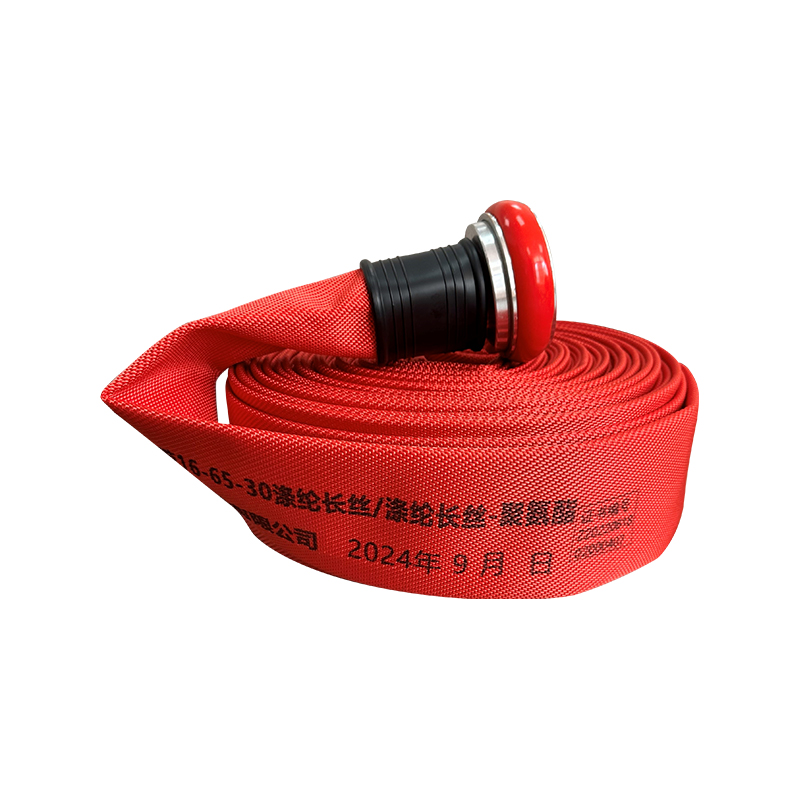
The primary firefighting hose used in active suppression. Available in 1.5", 1.75", and 2.5" diameters. Constructed with a woven outer jacket (polyester or nylon) over a synthetic inner liner rated for 250–400 PSI working pressure. The 2.5" line is the standard for significant structure fires; 1.75" is the most commonly deployed attack line in residential firefighting.
Supply / Relay Hose
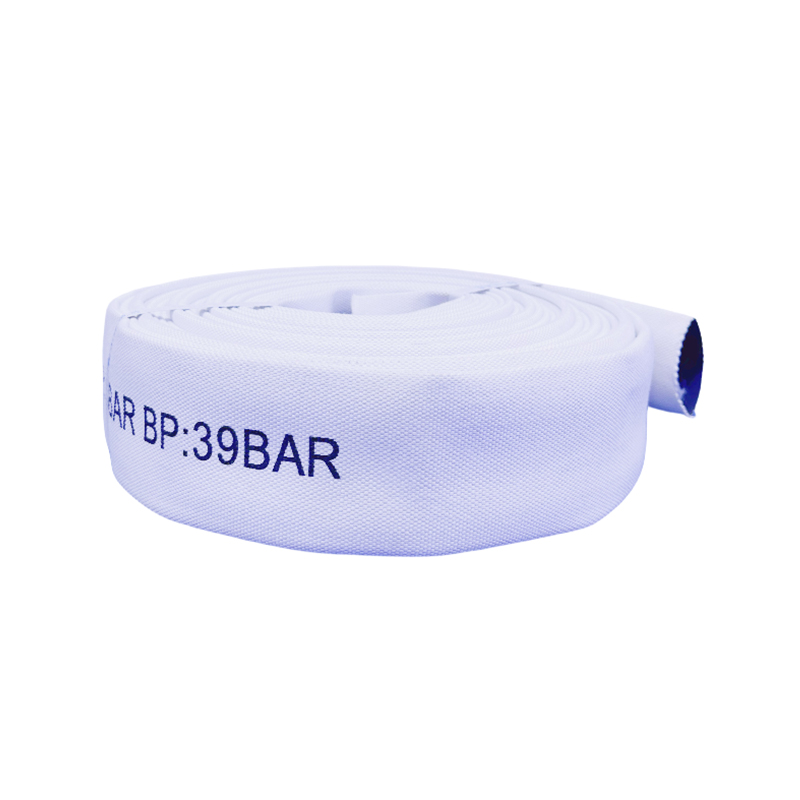
Large-diameter hose (LDH) used to move water from hydrants or water sources to the fire engine. Typically 4" or 5" diameter, operating at lower pressure (100–150 PSI) but very high volume. A 5" LDH can carry over 1,500 GPM. Constructed with a single or double jacket over a heavy rubber liner designed for forward-lay and reverse-lay operations.
Forestry / Wildland Hose
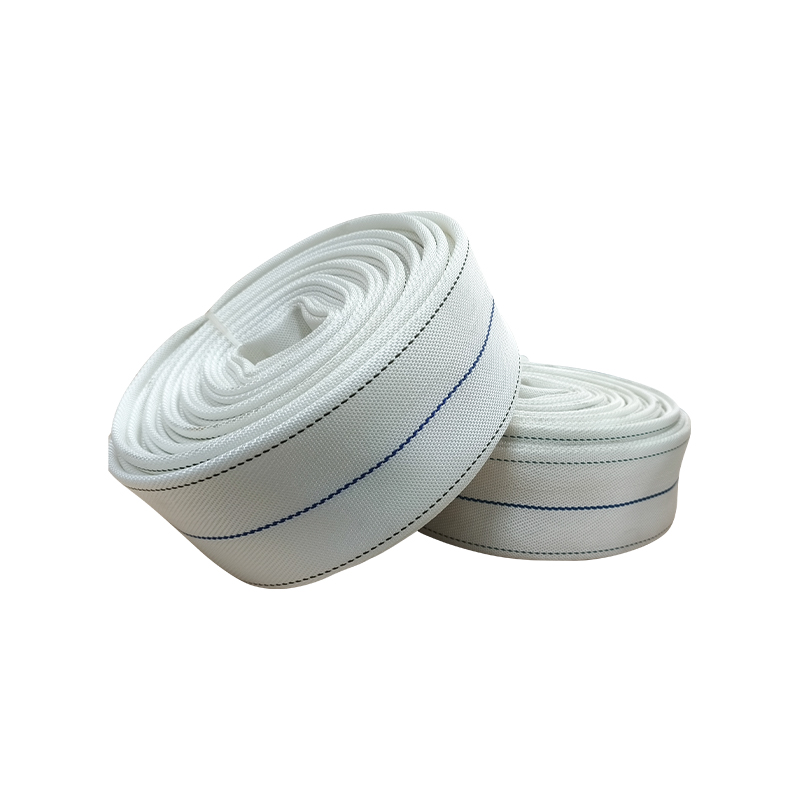
Lightweight, smaller-diameter hose (1" or 1.5") designed for wildland firefighting where portability over rough terrain is essential. Typically single-jacket construction. Operating pressure is lower — 100–150 PSI — and flow rates are modest. Designed to be carried and deployed on foot over long distances by hand crews.
Booster Hose
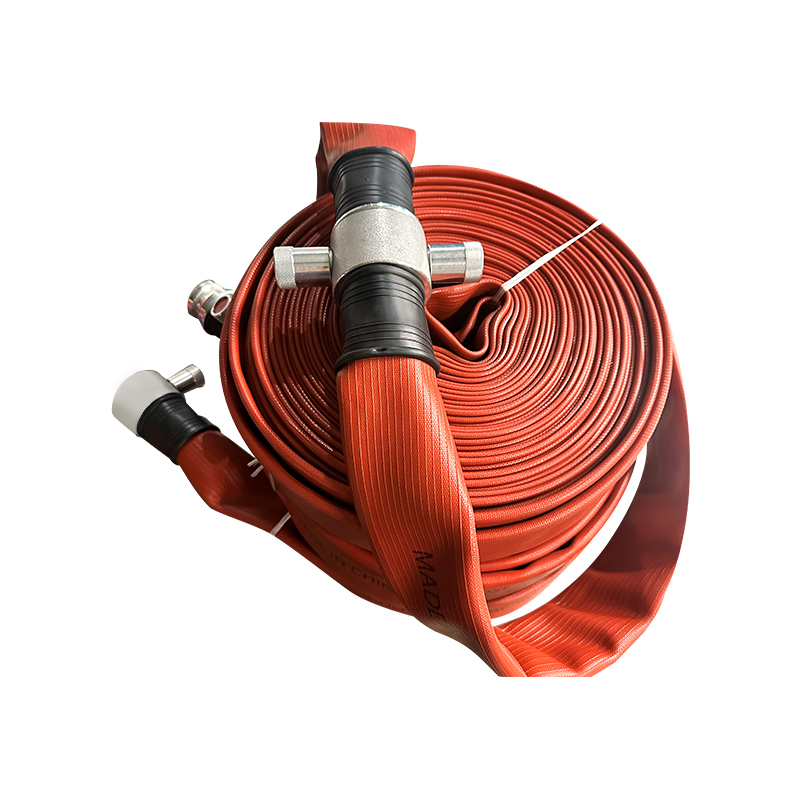
A rubber-jacketed, semi-rigid hose stored on a reel on the fire apparatus. Used for small initial attack on vehicle fires, refuse fires, and small structure fires. Self-supporting construction means it does not collapse when not pressurized. Diameter is typically 3/4" or 1", flow rates modest (25–50 GPM), but pressure can reach 250 PSI.
Building Fire Hose Reel
A fixed-installation, 19mm rubber hose on a swinging bracket or semi-rigid drum, permanently connected to the building's water supply. Required by building codes in commercial and industrial properties above a certain floor area. Pressure is regulated to approximately 45 PSI at the nozzle. Designed for untrained occupants to operate for immediate first-response suppression.
Standpipe / Cabinet Hose
Hose stored in fire cabinets within multi-story buildings, connected to the building's standpipe system. Comes in 1.5" and 2.5" variants — the 2.5" type is typically reserved for fire brigade use (Class I or III standpipes), while the 1.5" type is intended for trained occupants (Class II standpipes). Pressure requirements are set by NFPA 14 or equivalent local codes.
Fire Hose Pressure and Human Safety: A Practical Reference
Pressure is the critical variable when evaluating danger. The following reference table shows how water pressure relates to real-world effects on the human body and structures — important context for anyone working near fire suppression equipment:
| Pressure (PSI) | Source / Context | Effect on Person at 3m Distance | Risk Level |
|---|---|---|---|
| 5–10 PSI | Standard garden hose nozzle | Mild discomfort; no injury | Minimal |
| 30–50 PSI | Power washer (light-duty); fire hose reel | Surface skin abrasion at close range; eye injury risk without PPE | Low-Moderate |
| 80–100 PSI | Water cannon (riot control) | Knockdown, bruising, potential fractures in elderly/children | Moderate-High |
| 100–200 PSI | Fire attack hose (standard operations) | Severe blunt trauma, knockdown, potential internal injury, drowning risk | High |
| 200–300 PSI | High-pressure fire attack; aerial operations | Potentially fatal; serious trauma even at extended range | Severe |
Safety Rules Everyone Near a Fire Hose Should Know
Whether you are a building occupant who may need to use a hose reel, an industrial worker near fire suppression systems, or simply curious after seeing fire hose operations — these rules govern safe interaction with all fire hose systems: