en
en
 عربى
عربى
Content
- 1 What PVC Flat Hose Quality Control Covers
- 2 Raw Material Inspection Is the First Filter
- 3 Five Production Checkpoints That Catch Defects Early
- 4 Finished Product Testing and Hydraulic Validation
- 5 Batch Release Documentation and What Buyers Should Request
- 6 Frequently Asked Questions About PVC Flat Hose Quality Control
Field failures in PVC flat hose are rarely mysterious. A layer separates, a pinhole leaks, or a burst occurs at a fraction of the rated working pressure. In almost every case, the cause was a quality control step that was skipped, rushed, or measured with the wrong criteria. For buyers of irrigation, mining dewatering, or firefighting layflat hose, understanding how quality control works is the only reliable way to separate a durable product from a cosmetic one. PVC flat hose quality control is a structured chain of inspections that starts with raw resin pellets and ends only when a finished coil survives a hydraulic test.
What PVC Flat Hose Quality Control Covers
PVC flat hose quality control verifies raw material composition, monitors process parameters along the extrusion and reinforcement line, and validates finished hose against burst pressure, adhesion, and dimensional specifications. It is not a single inspection at the end of the line; it is a sequence of gates, each designed to stop a different class of defect.
Working definition
Quality control in PVC layflat hose manufacturing is the systematic inspection of every input, parameter, and output that determines whether a hose will hold pressure, resist abrasion, and keep its layers bonded over its service life.
A PVC flat hose is not a homogeneous tube. It is a three-layer composite:
- Inner PVC lining: must be pinhole-free and chemically compatible with the fluid.
- Polyester reinforcement yarn: carries the structural load and sets the burst pressure ceiling.
- Outer PVC coating: must resist abrasion, UV, and environmental ageing.
A defect in any of these layers degrades the entire hose, no matter how well the other layers perform. At Taizhou Jun'an Fire Technology Co., Ltd., our PVC lined layflat hose is manufactured under this exact sequence of controls, beginning with raw material verification and ending with batch-level pressure testing. Buyers who want to compare PVC performance against other materials can use our guide to selecting PVC layflat hoses by pressure rating and durability.
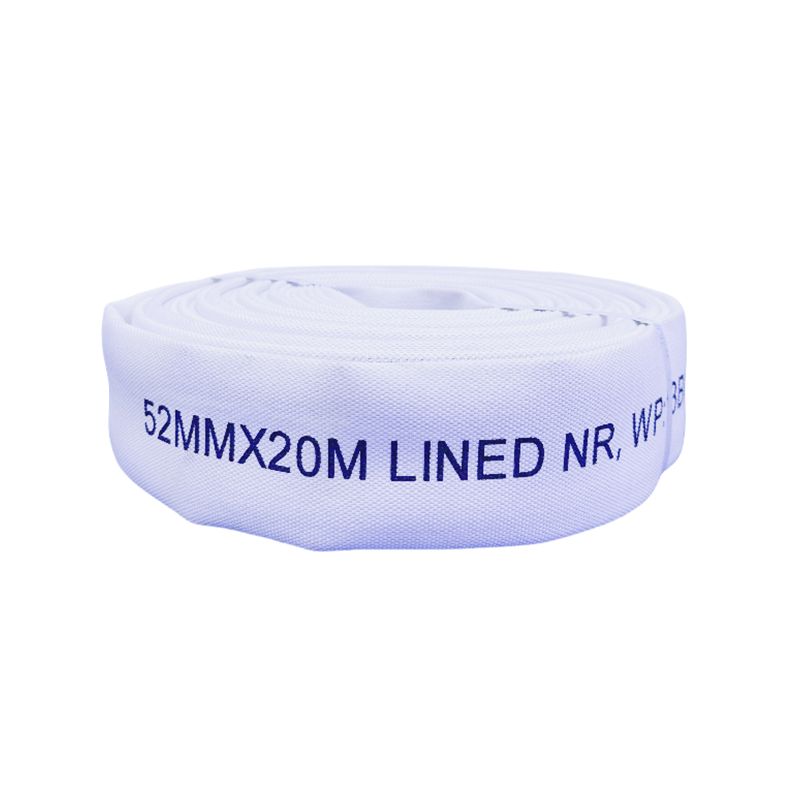 Wholesale Canvas Hose For Fire Extinguishing/Agricultural IrrigationTaizhou Jun'an Fire Technology Co., Ltd. Is China Wholesale Canvas Hose Suppliers, Exporter, Our Canvas Hose Is Mainly Used For Fire Figh...View Product →
Raw Material Inspection Is the First Filter
Raw material inspection prevents defective PVC resin, underspecified yarn, and off-spec plasticizers from entering production, which is where most hidden quality problems are born. A fault caught here costs minutes; the same fault discovered after extrusion costs an entire batch.
Resin, yarn, and plasticizer verification
Not all PVC resin is the same. The K-value determines molecular weight and directly influences the strength and flexibility of the finished lining. Off-spec K-value yields a lining that is either too soft and prone to deformation or too brittle and prone to cracking. The polyester yarn is the structural backbone: its tenacity, linear density, and twist level control how much burst pressure the hose can sustain. Plasticizer content, in turn, determines low-temperature flexibility. Too little plasticizer makes the hose stiff and cracking-prone; too much can bleed out and weaken layer adhesion.
| Material | Test | Acceptance criterion |
| PVC resin | K-value | 65–72 |
| PVC resin | Impurities / white point | Grade A, no visible specks |
| Polyester yarn | Tenacity | ≥ 6.5 g/denier |
| Polyester yarn | Linear density deviation | ≤ ±3% |
| Plasticizer | Ash content | ≤ 0.3% |
| Plasticizer | Acid value | ≤ 0.5 mg KOH/g |
A single bad yarn lot can produce hundreds of coils that all fail under pressure. That is why qualified factories test every yarn delivery, not just the first one.
Five Production Checkpoints That Catch Defects Early
Production checkpoints on the extrusion and reinforcement line catch defects while they can still be corrected, which is faster and cheaper than testing every finished coil and scrapping rejects. These five checkpoints appear on every controlled production line for PVC layflat hose:
-
Inner lining extrusion
Melt temperature held at 170–190°C; wall thickness tolerance within ±0.2 mm.
-
Yarn reinforcement wrapping
Uniform tension and spacing; no exposed yarn, overlapping strands, or knots.
-
Outer coating extrusion
Concentricity within ±0.3 mm; no pinholes, bubbles, or gel particles.
-
Cooling and sizing
Final diameter tolerance per engineering standard; ovality below 2%.
-
Inline leak and pressure test
Every meter of hose is tested at 1.5× working pressure before it is wound onto the coil.
Finished Product Testing and Hydraulic Validation
Finished product testing validates that a completed production batch meets its rated burst pressure, layer adhesion, dimensional, and environmental resistance values before shipping. Every batch that leaves a certified production line is accompanied by measured results, not assumptions.
| Test | Method | Minimum acceptance |
| Burst pressure | Hydrostatic pressure raised to rupture | ≥ 2.5× rated working pressure |
| Layer adhesion | 25 mm strip peel | ≥ 30 N/cm |
| Cold flexibility | Bend at -5°C | No cracking or delamination |
| UV resistance | 300 h accelerated exposure | No surface cracks |
| Dimensional check | OD measurement at 3 points | Within ±1 mm of specification |
Burst pressure retention after accelerated aging, PVC flat hose
Illustrative retention values from accelerated aging tests on production PVC flat hose samples.
Batch Release Documentation and What Buyers Should Request
Batch release documentation is the proof that quality control was actually performed, and buyers should treat missing certificates as a warning sign, not a paperwork detail.
A complete test certificate should include the lot number, hose diameter, working pressure rating, burst pressure result, adhesion value, outer diameter measurement, test date, and the inspector's code. Sampling rules vary, but 3 coils or 10% of a batch, whichever is greater, is a practical baseline for visual and dimensional verification. For dimension verification, our PVC layflat hose sizing guide lists standard diameters and tolerances that a test certificate should reference. After delivery, storage and cleaning have a direct effect on service life; the comprehensive PVC flat hose usage and maintenance guide is a useful companion to your quality documentation.
OEM buyers should require traceability from finished coil back to resin lot, yarn lot, and production shift. If a supplier cannot trace backward, you cannot recall forward.
Frequently Asked Questions About PVC Flat Hose Quality Control
How is burst pressure verified for PVC flat hose?
Burst pressure is verified by hydrostatic testing. Samples from each batch are filled with water, pressurized until rupture, and the recorded burst value must reach at least 2.5 times the rated working pressure. A burst result below that threshold rejects the batch.
What is the difference between 100% inline testing and batch sampling?
Inline testing checks every meter of hose during production for leaks and wall integrity, usually with low-pressure air. Batch sampling physically tests a small number of finished coils for burst pressure, adhesion, and dimensions. Both are needed because they answer different questions.
What should a quality test certificate include for PVC flat hose?
A test certificate should include the lot number, hose diameter, working pressure rating, burst pressure result, adhesion strength, outer diameter measurement, test date, and the signature or code of the responsible inspector. If any of these is missing, the certificate is incomplete.
Can buyers request third-party inspection on PVC flat hose orders?
Yes. Third-party inspection for PVC flat hose typically covers dimensional verification, burst pressure testing, visual inspection, and packing condition. Most direct manufacturers, including Taizhou Jun'an Fire Technology Co., Ltd., accept this as a standard arrangement for first-time orders.