en
 عربى


Content
- 1 What Makes an Industrial Environment Demanding for a Hose Lining
- 2 How EPDM Chemistry Translates into Field Performance
- 3 Thermal and Chemical Limits You Must Design Around
- 4 Inside an EPDM Lined Hose: Construction and Quality Control
- 5 Pressure, Couplings and System Compatibility
- 6 Cost of Ownership: The Arithmetic Behind the Upgrade
- 7 Specifying EPDM Hoses: A Short Buyer Checklist
- 8 Practical Questions Industrial Buyers Ask
EPDM lined fire hoses hold a continuous service window of roughly -40 °C to +120 °C, retain more than 80% of their original tensile strength after 1,000 hours of heat ageing at 100 °C under ASTM D573, and show no cracking after ozone exposure at 50 pphm and 40 °C under ASTM D1149.
Those three figures explain why the lining is specified in steel mills, chemical plants, mine dewatering lines and tunnel washdown systems, where PVC and nitrile linings often give out within two to four years.
Most industrial hose failures are not burst failures. They begin as a hairline crack at a fold line, a liner edge that has swollen next to a coupling, or a cover that chalked grey after a summer on an outdoor rack. Each of those is a material property problem, and each is where an EPDM lining separates itself from a cheaper alternative.
Definition: an EPDM lined fire hose is a reinforced hose whose waterway is a peroxide-cured ethylene propylene diene monomer rubber tube, bonded to a woven polyester or nylon jacket and terminated with a coupling rated to the hose working pressure.
What Makes an Industrial Environment Demanding for a Hose Lining
An industrial environment counts as demanding when four measurable stressors act on the same hose: sustained temperature above 60 °C, contact with steam, glycols, dilute acids or solvents, outdoor UV and ozone exposure, and mechanical cycling through coiling, dragging and abrasion.
Temperature is the first filter. PVC linings soften and lose plasticiser above roughly 60 °C, so a 70 °C washdown loop takes them out of the conversation. Nitrile handles heat better but chalks quickly in direct sun. TPU tolerates abrasion well, yet its practical ceiling sits near 80 °C.
Chemistry is the second filter, and it is the one buyers get wrong most often. EPDM handles hot water, steam, glycols, ketones and alcohols. It does not handle mineral oil, fuel or aromatic solvents. Matching the lining to the medium matters more than matching it to the price list.
A PVC hose that costs 40% less but is replaced three times as often carries a higher annual cost per metre of water moved, before any downtime is counted.
How EPDM Chemistry Translates into Field Performance
EPDM is a saturated hydrocarbon rubber. Its polymer backbone carries no carbon-carbon double bonds, so ozone, oxygen and ultraviolet light have almost nothing to attack, and peroxide curing leaves no reactive unsaturation behind.
Two consequences follow. The lining survives outdoor storage and sun-exposed racks that crack nitrile or natural rubber covers within a single season. At the same time, that same saturation makes EPDM non-polar, which is why liner-to-jacket adhesion is the hardest step in building the hose: polyester fabric will not bond to a non-polar rubber without a resorcinol-formaldehyde-latex (RFL) treatment or an added tie layer. A hose with a properly bonded EPDM liner is an engineered assembly, not an extrusion pushed into a jacket.
The table below compares the four linings most often quoted for industrial duty.
| Lining | Continuous temperature | Ozone and UV | Mineral oil and fuel | Abrasion |
| EPDM | -40 °C to +120 °C | Excellent | Poor, swells | Very good |
| PVC | -10 °C to +60 °C | Good | Fair | Moderate |
| TPU | -40 °C to +80 °C | Good | Very good | Excellent |
| Nitrile (NBR) | -30 °C to +100 °C | Fair | Excellent | Good |
Ask for peel test results from the production lot. A type-test certificate from a sample built two years ago tells you nothing about the hose that will be shipped next month.
Thermal and Chemical Limits You Must Design Around
EPDM holds continuous service from -40 °C to +120 °C and resists steam, hot water, glycols, dilute acids and alkalis. It fails in hydrocarbon service: ASTM D471 immersion in IRM 903 oil can drive volume swell past 100%, which is a specification error rather than a hose defect.
Index values reflect typical compound performance under ASTM D471 immersion, ASTM D1149 ozone and ASTM D573 heat ageing tests.
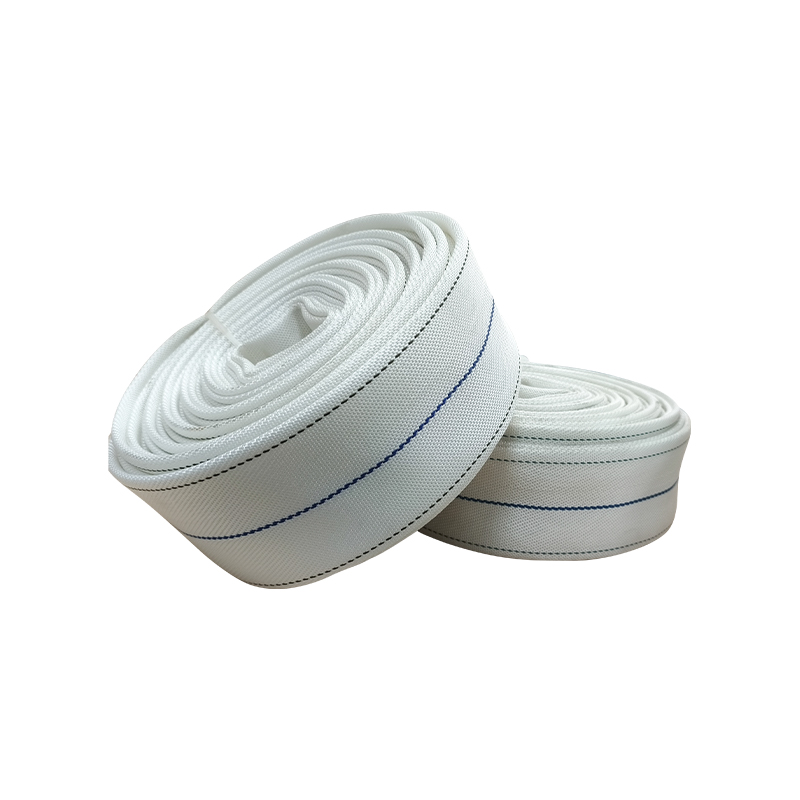
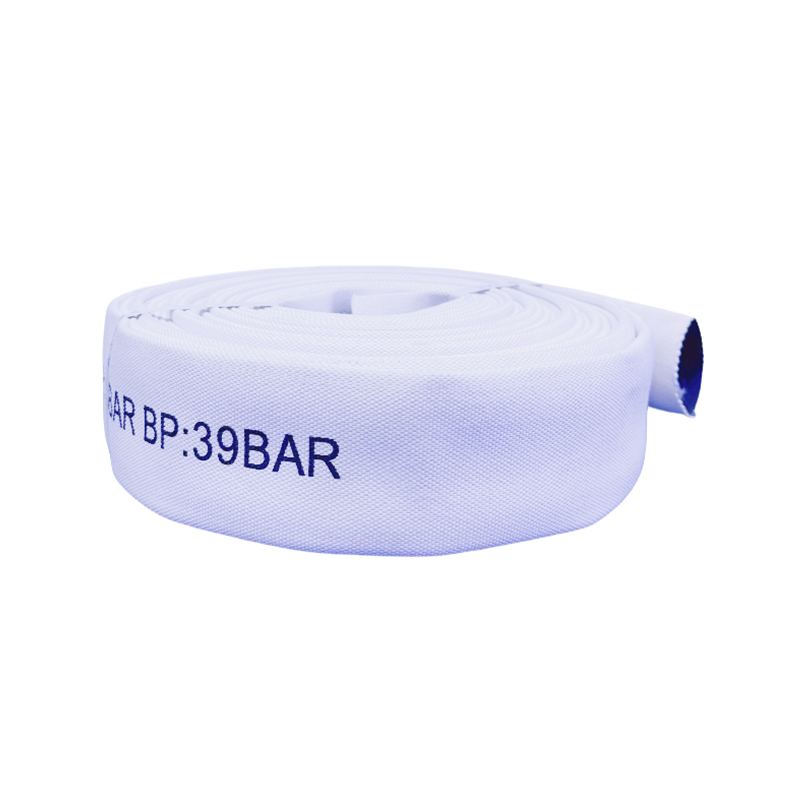
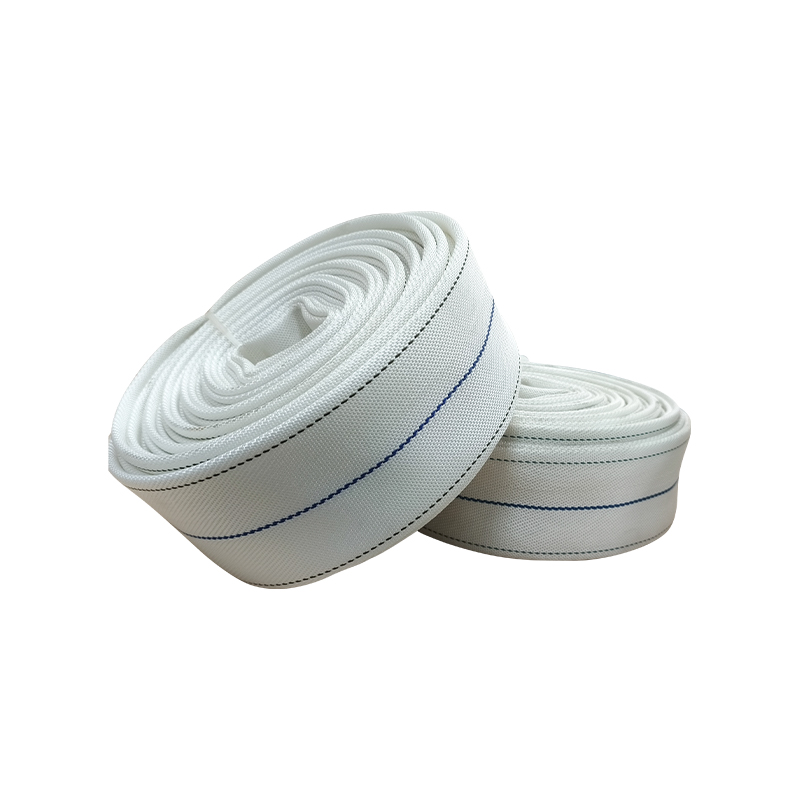 EPDM Lined Fiber Canvas Fire Extinguishing Flat HoseFor water, steam, glycol and mild chemistry, this EPDM-lined fiber canvas flat hose suits fire suppression and industrial water transfer.View Product →
Specify the medium before the lining. Water, steam, glycol and mild chemistry point to EPDM; oils, fuels and aromatic solvents point to nitrile or TPU.
Inside an EPDM Lined Hose: Construction and Quality Control
A production-grade EPDM lined hose passes five controlled stages, and the burst and adhesion figures you should request come from the last two.
- Compound mixing. EPDM base polymer, carbon black, plasticiser and a peroxide cure system are mixed to a target hardness of 60 to 75 Shore A and a tensile strength of 10 to 15 MPa.
- Liner extrusion. The rubber tube is extruded to a wall thickness of roughly 1.5 to 2.5 mm. Concentricity matters, because a thin spot becomes the first puncture point.
- Jacket weaving. Polyester warp and weft are woven over the tube at a density that sets both the burst ratio and the fatigue life of the finished hose.
- Adhesion bonding. RFL-treated fabric or a tie layer binds the jacket to the non-polar liner, and peel tests belong on production lots rather than on a one-off sample.
- Vulcanisation and proof test. Steam autoclave curing at 150 to 160 °C crosslinks the compound, after which each length is hydrostatically proof tested and a burst sample is pulled from the lot.
The proof test is the cheapest insurance in the order. It converts an untested roll of rubber and fabric into a documented pressure component with a traceable lot number.
Pressure, Couplings and System Compatibility
Specify a burst-to-working ratio of at least 3:1, and step up to 4:1 for mining dewatering lines that see daily pressure cycles above 10 bar.
- Working pressure and burst pressure should appear on the hose marking, not only on the quotation.
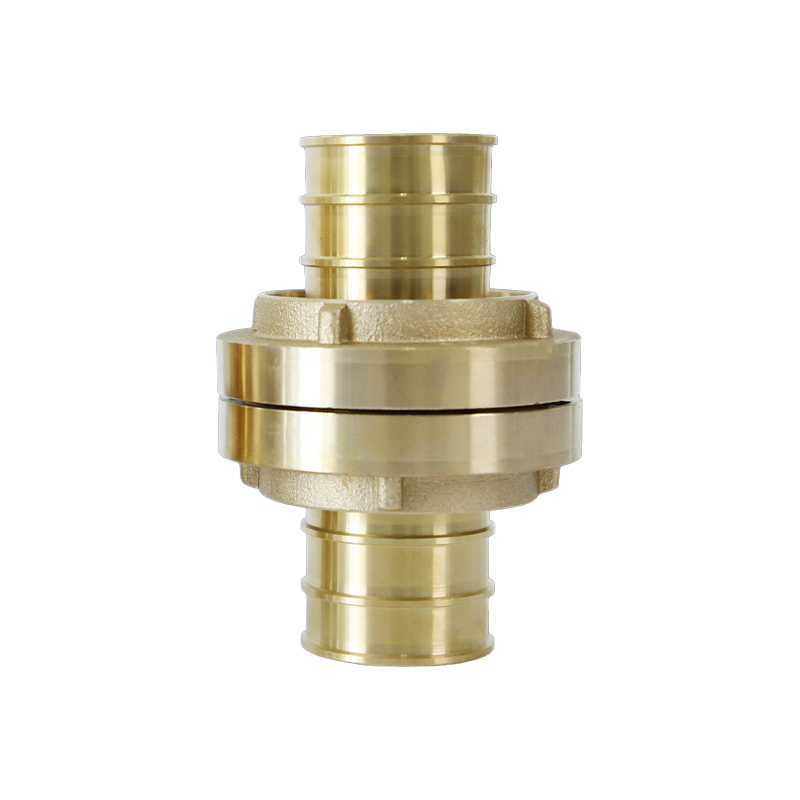
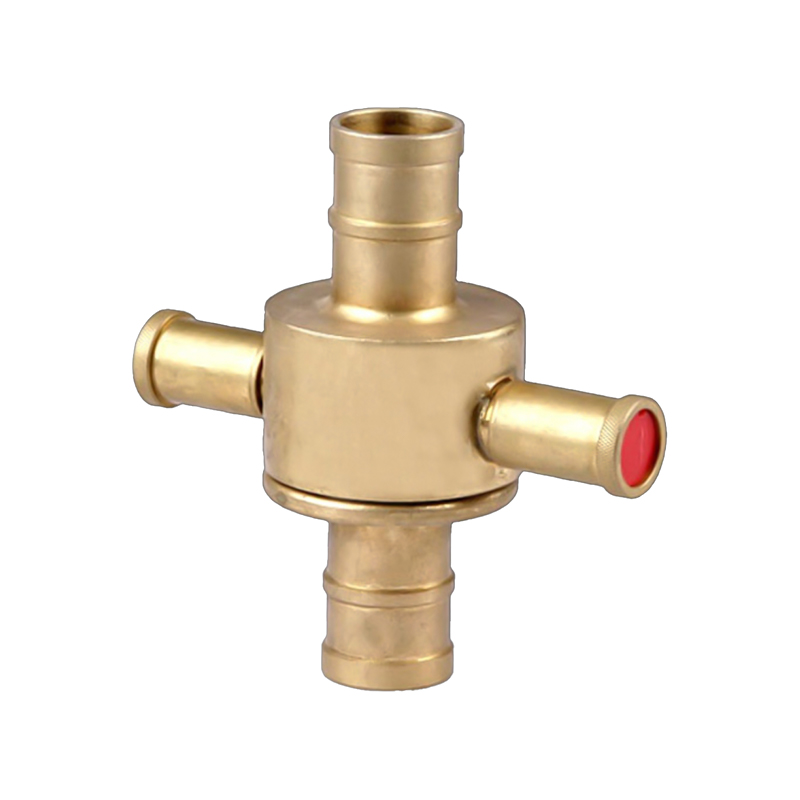
- Coupling type follows the site rather than the factory: Storz for high-flow mining and municipal work, BS instantaneous and John Morris for the United Kingdom, GOST for CIS markets, American rocker-lug for North America, Machino and Italian patterns across the European Union.
- Coupling material has to suit the medium. Aluminium is common for fire duty, while stainless steel or brass is chosen where corrosion is a factor.
- Bend radius and coil diameter decide how the hose behaves on a reel. A hose that kinks at a 0.5 m radius will not run on a compact reel.
Interface standards matter once imported equipment is on site. A 4-inch, 6-inch or 8-inch mining outer-dewatering hose supplied with Storz couplings connects to the same manifold regardless of pump brand, which keeps spare-hose inventory simple across a whole site.
Standardise on one coupling family per site. Mixed inventories are the second-largest cause of delayed hose replacement, after missing burst certificates.
Cost of Ownership: The Arithmetic Behind the Upgrade
If an EPDM lined hose costs 2.5 times a PVC equivalent and lasts three times as long, annualised lining cost falls by about 17%: 2.5 divided by 3 equals 0.83, or 83% of the baseline.
That arithmetic leaves out the larger number. A dewatering line stopped by a failed hose consumes a two-person crew, a shutdown window and a replacement ordered under time pressure. Buyers who track EPDM hose durability and investment planning generally find that the second and third replacement intervals are where the savings accumulate.
Heat ageing data drives the replacement schedule, not the calendar. ASTM D573 testing at 100 °C gives a defensible basis for setting inspection intervals at 12 months.
Specifying EPDM Hoses: A Short Buyer Checklist
Six data points separate a service-grade EPDM hose from a catalogue lookalike.
- Compound grade, cure system and hardness range of the lining.
- Liner wall thickness with the manufacturing tolerance stated in millimetres.
- Adhesion peel data from the production lot, not a type-test report.
- Burst test certificate referencing EN 694, NFPA 1961 or UL 19.
- Coupling standard, material and thread or lug dimensions.
- Marking, packaging and OEM or ODM requirements for private-label buyers.
Specify EPDM when the medium is
- Hot water or steam to 120 °C
- Water-glycol mixtures
- Dilute acids and alkalis
- Outdoor or UV-exposed service
Specify nitrile or TPU when the medium is
- Mineral oil or hydraulic fluid
- Petrol, diesel or kerosene
- Aromatic solvents
- Heavy abrasive slurry above 80 °C
Taizhou Jun'an Fire Technology Co., Ltd. produces EPDM lined fire hose, EPDM semi-rigid hose and mining outer-dewatering hose in its own factory, with couplings matched to American, Storz, GOST, BS, Machino and Italian standards. The company answers enquiries within 12 hours on working days and builds OEM and ODM orders to customer samples.
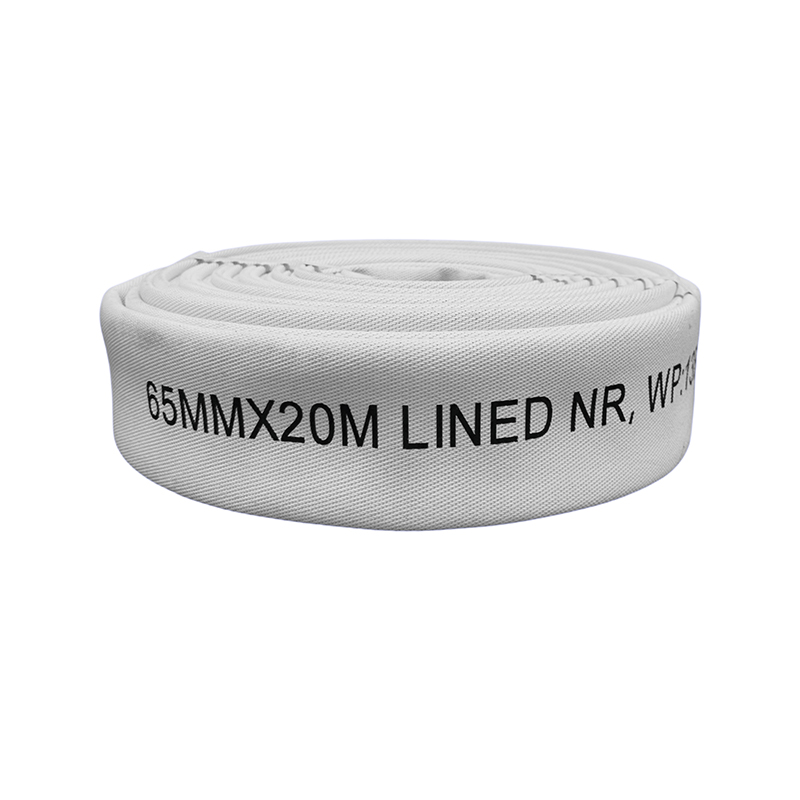 EPDM Semi-Rigid Flat Hose for Chemical and Fire ServiceFor chemical plants, hazardous material handling and fire protection, this EPDM semi-rigid hose resists acids, alkalis and abrasion while flat-folding for storage.View Product →
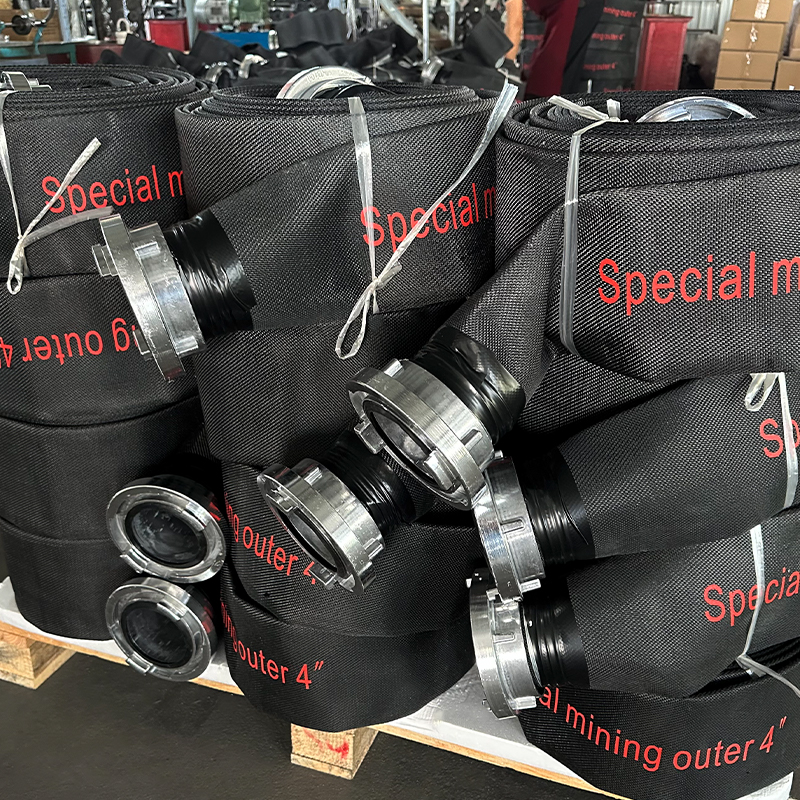 4-Inch Mining Dewatering Hose with Storz CouplingModel M-DW-400 supports high-intensity mine drainage and slurry discharge with an abrasion-resistant cover and quick Storz coupling.View Product →
For an overview of hose types, diameters and coupling ranges, review the fire hose and emergency equipment range.
Practical Questions Industrial Buyers Ask
What temperature range can an EPDM lined fire hose handle?
Continuous service runs from -40 °C to +120 °C with standard peroxide-cured compounds. Short excursions to 150 °C are possible in steam duty with a compound formulated for it, but sustained operation above 120 °C accelerates hardening and shortens the inspection interval.
Can EPDM lined hoses carry oil or fuel?
No. EPDM swells in hydrocarbon media, and ASTM D471 immersion in IRM 903 oil typically drives volume swell past 100%. Nitrile or TPU linings are the correct choice for oil, fuel and aromatic solvent transfer.
What burst-to-working ratio should a mining dewatering hose carry?
A minimum of 3:1 for standard duty, and 4:1 where pressure cycles above 10 bar repeat daily. The ratio should appear on the hose marking and be supported by a lot-specific hydrostatic test certificate.
How long should an EPDM lined hose last in industrial service?
With a properly bonded liner and correct storage, service intervals of 8 to 12 years are achievable in water, steam and glycol duty, against 3 to 5 years for PVC under the same conditions. Heat ageing data at 100 °C is the practical basis for setting those intervals.
Lining choice is a chemical decision first and a price decision second. Match EPDM to water, steam and glycol duty, and hose replacement stops being an annual line item.