en
 عربى


Content
- 1 What a Double Jacket Fire Hose Is
- 2 Why Two Woven Layers Hold Higher Pressure
- 3 Friction Loss Decides the Diameter You Buy
- 4 Pressure Ratings and the Standards Behind Them
- 5 The Coupling Is the Pressure Boundary
- 6 Failure Modes and the Inspection Routine That Prevents Them
- 7 Specifying Double Jacket Hose for a High-Pressure System
- 8 Direct Answers on Pressure, Sizing, and Service Life
Double jacket fire hose exists because of one physical problem: the liner holds the water, and something has to stop the liner from expanding. A single woven jacket handles that at 150 to 200 psi. At 250 psi and above, with a surge every time a nozzle closes quickly, one jacket would have to absorb all the hoop stress and all the outside abrasion at the same time. Two layers split the job.
What a Double Jacket Fire Hose Is
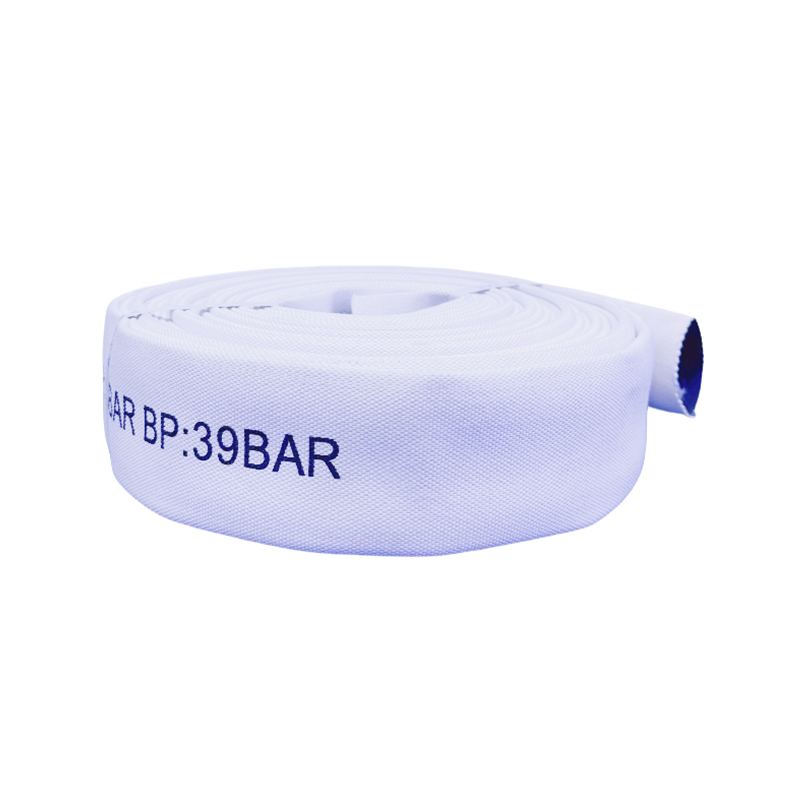
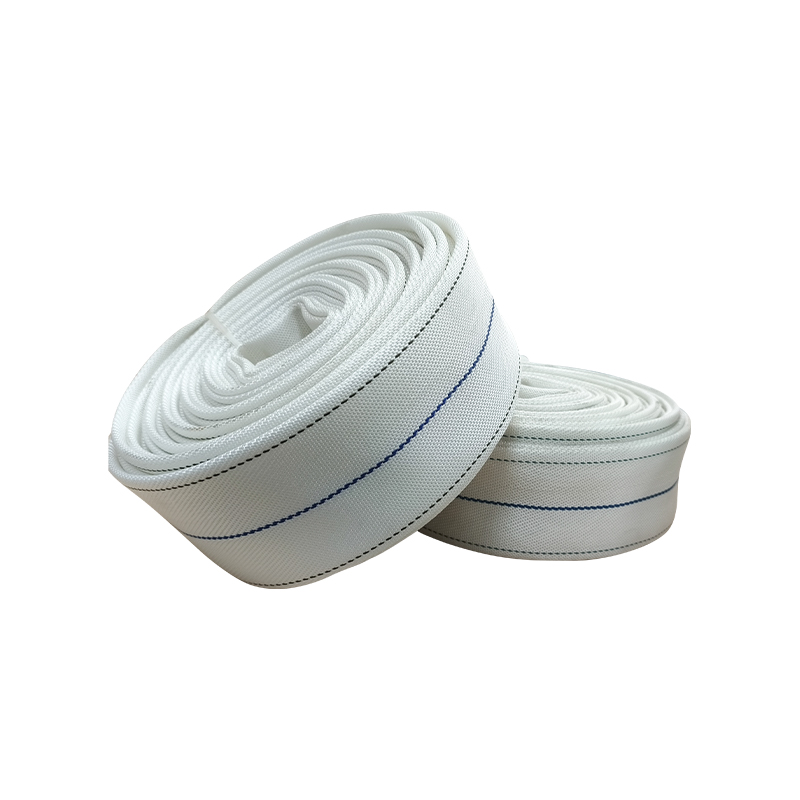
A double jacket fire hose is a hose assembly with one inner liner and two separately woven outer jackets, a combination that supports working pressures of 250 psi to 400 psi and delivers roughly two to three times the abrasion life of a single jacket hose in the same diameter.
Liner material sets the temperature and chemical ceiling
The jacket carries the load. The liner decides what the hose can be asked to move and at what temperature, and four materials cover almost all high-pressure fire service.
- EPDM: continuous service from minus 40 to plus 100 degrees Celsius, with strong ozone and UV resistance, which is why it dominates rack hose and outdoor attack lines.
- TPU: rated to about 90 degrees Celsius, with the highest abrasion resistance per unit of wall thickness and lower weight than rubber-lined hose of the same size.
- Nitrile (NBR): oil and fuel resistance for industrial and petrochemical standpipes where hydrocarbon contact is possible.
- Natural and synthetic rubber: high flexibility and low kink memory, common where hose is dragged across concrete or gravel.
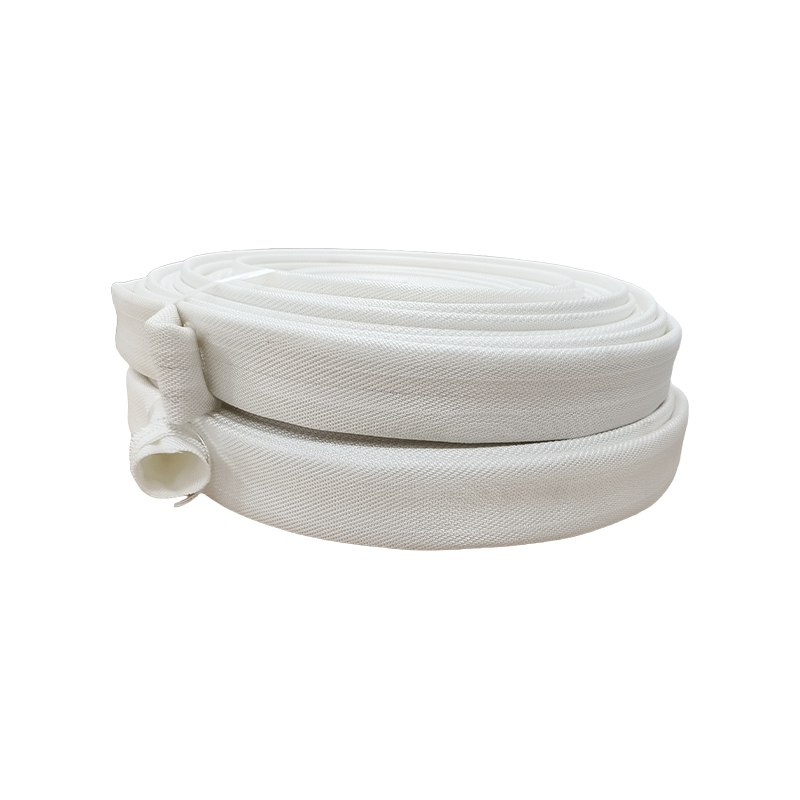
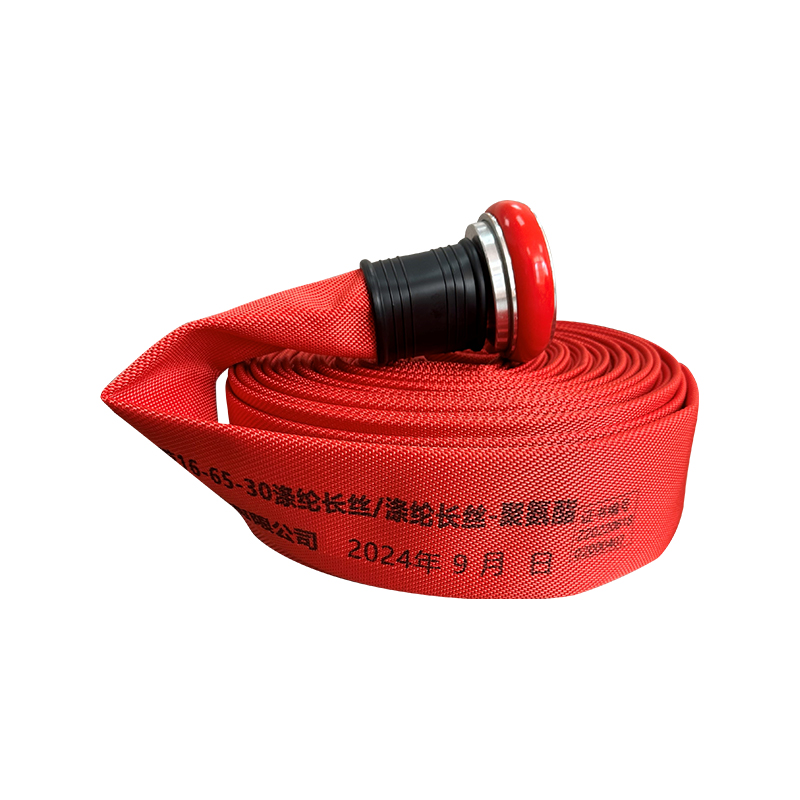
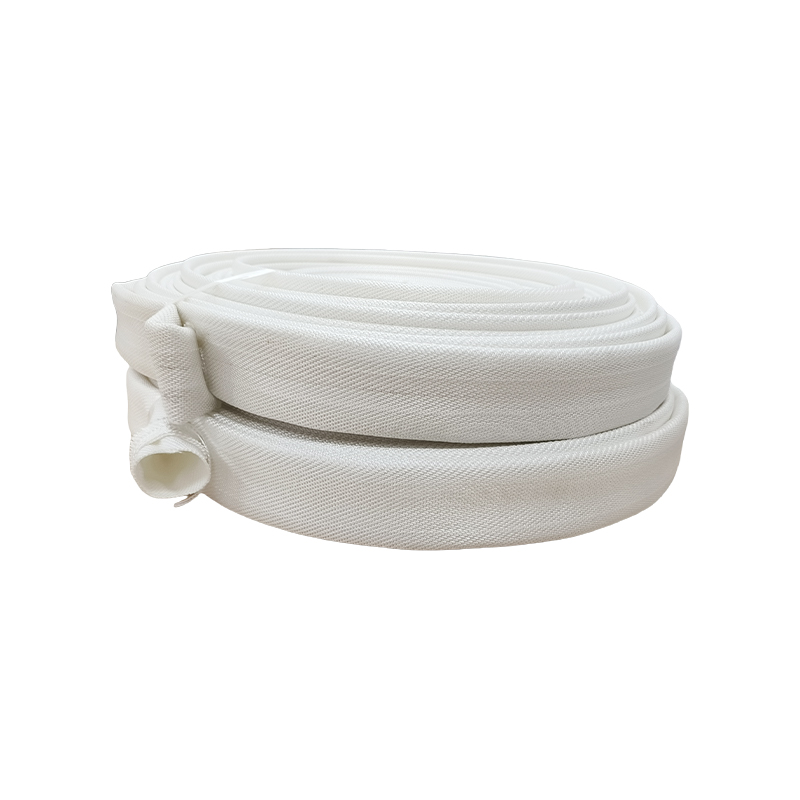 Double Jacket Oil & Chemical Resistant Fire HoseA two-layer reinforced jacket and EPDM/NBR liner suit aggressive fire-service environments; the outer jacket adds abrasion protection and supports burst performance.View Product →
How the two jackets are woven
In circular weaving, warp yarns run lengthwise and weft yarns wrap circumferentially. The weft yarns carry the hoop stress generated by internal pressure, so pick count per inch, not jacket thickness, is the figure that predicts burst performance. A second jacket at a moderate pick count outperforms a single jacket at a high pick count, because the outer layer also shields the inner layer from abrasion.
| Property | Single jacket | Double jacket |
| Woven jacket layers | 1 | 2 |
| Working pressure range | 150 to 200 psi | 250 to 400 psi |
| Typical burst pressure | 450 to 600 psi | 750 to 1,000 psi |
| Abrasion resistance | Baseline | 2x to 3x baseline |
| Weight, 50 ft length | About 11 lb | About 15 lb |
Why Two Woven Layers Hold Higher Pressure
Two jackets raise burst pressure because hoop stress is shared across roughly twice the yarn cross-section, and they extend field life because the outer jacket can wear through without the liner ever being exposed.
Surge pressure matters as much as steady pressure. Closing a nozzle or a quarter-turn valve in under two seconds commonly drives line pressure to 1.5 or 2 times the static reading on the gauge. A hose rated 250 psi with a 3:1 burst ratio absorbs that surge with no permanent elongation. A hose rated 150 psi with a 2:1 ratio takes the same surge straight into its single jacket.
Friction Loss Decides the Diameter You Buy
At a 200 gpm target flow, friction loss runs about 96 psi per 100 feet in 1.5-inch hose, 62 psi in 1.75-inch, 32 psi in 2-inch, 8 psi in 2.5-inch, and 3 psi in 3-inch hose, using the standard fire-ground friction loss coefficients.
The underlying expression is FL = C x Q x Q x L, where Q is flow in hundreds of gpm, L is length in hundreds of feet, and C is 24 for 1.5-inch, 15.5 for 1.75-inch, 8 for 2-inch, 2 for 2.5-inch and 0.8 for 3-inch hose. Diameter, not pressure rating, is what buys reach at the nozzle.
Pressure Ratings and the Standards Behind Them
In North America, NFPA 1961 governs how fire hose is built, marked and proof tested, NFPA 1962 sets the annual service test and inspection routine, and UL 219 covers listed hose assemblies. In Europe, EN 14540 covers semi-rigid fire hose and ISO 4642-1 defines the international semi-rigid classification used in fixed systems.
| Standard | Scope | Practical requirement |
| NFPA 1961 | Manufacture and marking | Proof testing and service test pressure marked on the jacket |
| NFPA 1962 | Care, use and testing | Annual service test plus visual inspection after each use |
| UL 219 | Listed fire hose | Third-party verification of the finished assembly |
| EN 14540 | Semi-rigid fire hose | Pressure and kink performance for European fixed systems |
| ISO 4642-1 | Semi-rigid classification | Size, pressure and performance classes for international projects |
The Coupling Is the Pressure Boundary
A hose assembly fails at its weakest point, and in high-pressure systems that point is usually the coupling attachment. A 2.5-inch Storz coupling in hard-anodized aluminum with an EPDM gasket is rated for the same 250 psi to 400 psi band as the hose it terminates, but only when the swage or banded ferrule is specified against burst pressure instead of working pressure.
- Storz: a sexless coupling from DN25 to DN200 with no male or female side, standard in Germany, Denmark and mining dewatering lines.
- American NH / NST: threaded couplings for United States hydrants, standpipes and apparatus.
- GOST: the Russian and CIS connection standard for municipal and industrial fire service.
- Machino: the Japanese standard for municipal and industrial hose lines.
- John Morris BS Instantaneous: the United Kingdom standard for hose reels and attack lines.
- Guilemin DSP and Italian UNI: national standards still found across France and Italy.
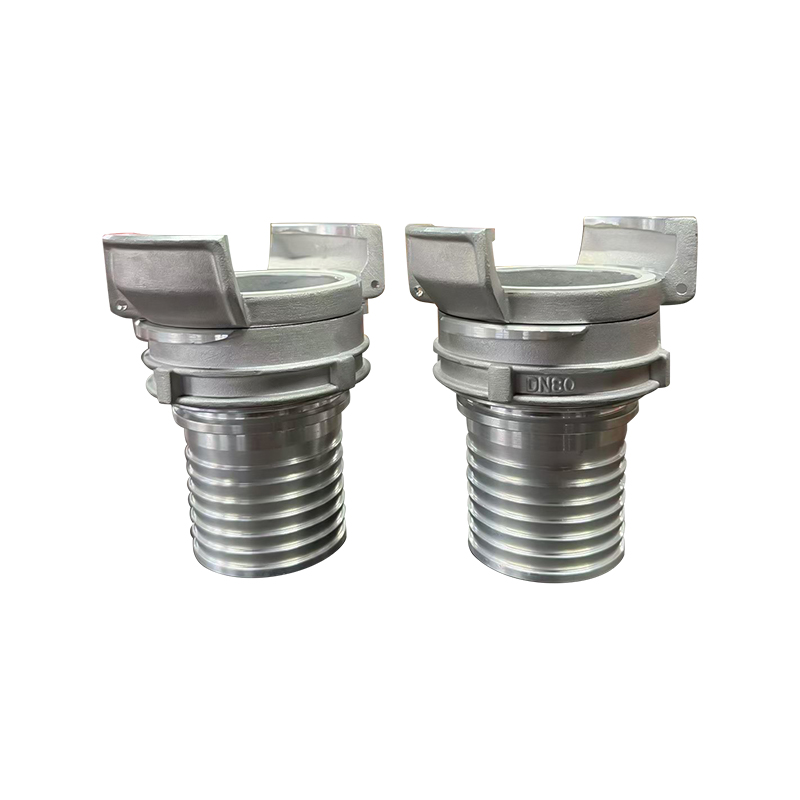
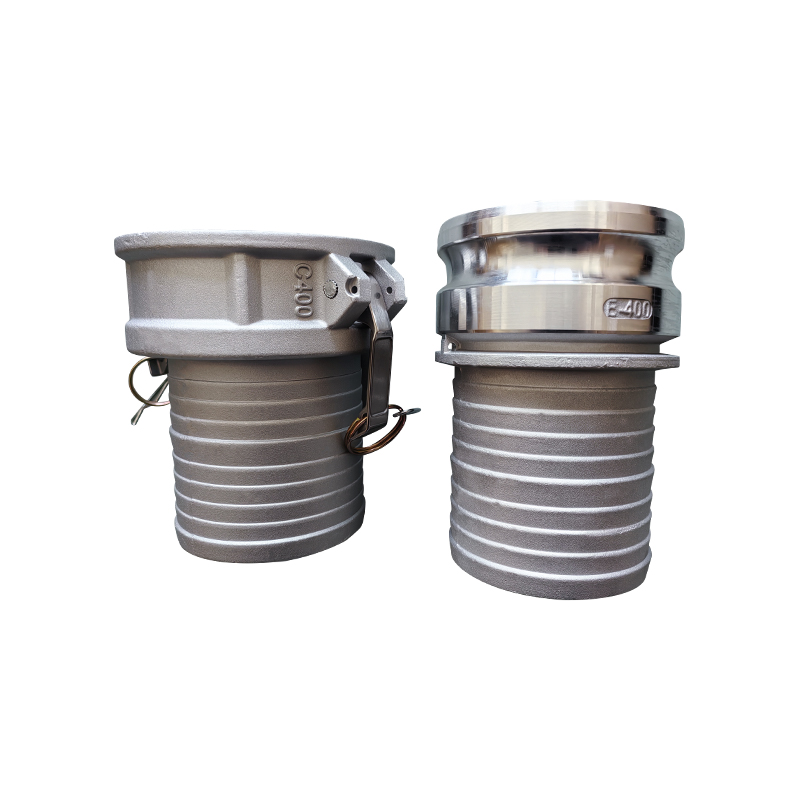
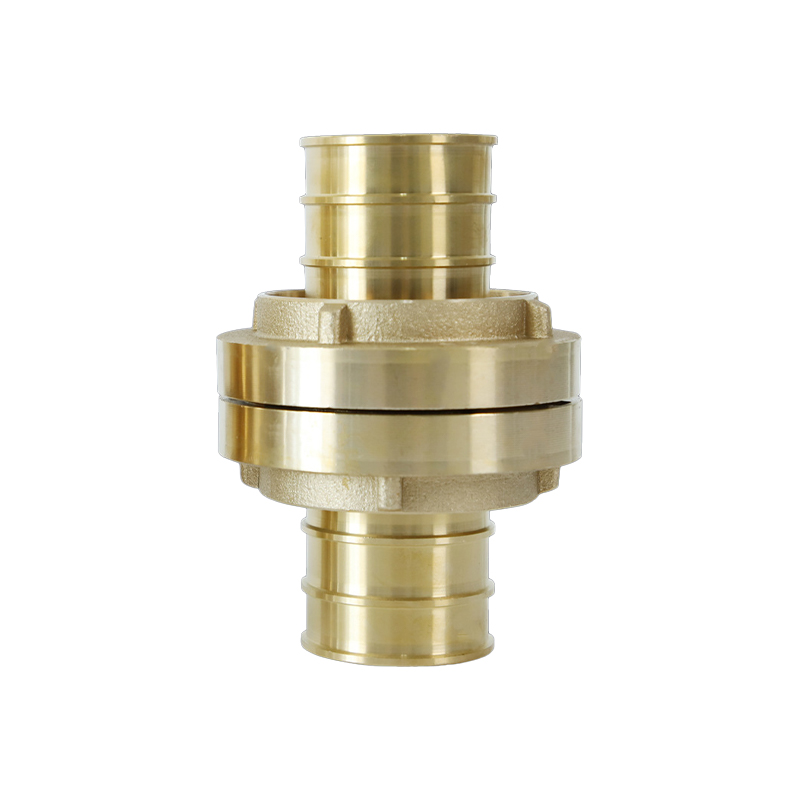 Storz and Camlock Quick-Release Hose CouplingsPressure-rated quick couplings in aluminum, stainless, or brass offer tool-free Storz and camlock connections for fire hose and industrial transfer.View Product →
Failure Modes and the Inspection Routine That Prevents Them
Four failure modes account for most high-pressure hose losses: outer jacket abrasion, liner delamination, coupling pull-off, and mildew rot in hose stored wet. All four are visible months before the hose bursts.
- After every use, drain the hose, brush off abrasive grit, and inspect both jackets for cuts that expose the liner.
- Every month, check rack and reel hose for flat spots, mildew odor, and damaged coupling threads or locking arms.
- Every year, service test each length at the pressure marked on the jacket, following NFPA 1962 where it applies.
- After any recoupling or repair, retest the length before it goes back onto a truck or rack.
- Before each shift, run a hose bed or rack check and pull damaged lengths out of service immediately.
Specifying Double Jacket Hose for a High-Pressure System
A defensible specification carries five numbers: working pressure, minimum burst ratio, inside diameter, liner material, and coupling standard. Everything else on a data sheet is preference.
- Working pressure: 250 psi minimum for 1.5-inch and 1.75-inch attack lines, and 300 psi to 400 psi for fixed industrial racks.
- Burst ratio: at least 3:1 against working pressure, stated as a number on the data sheet rather than as a claim.
- Inside diameter: derived from the friction loss figures above, not from whatever diameter is already on the truck.
- Liner: EPDM for hot water and outdoor duty, TPU where weight and abrasion resistance matter most.
- Coupling standard: matched to the pump, standpipe or hydrant already installed at the destination.
- Lighter per length, easier to repack
- Best abrasion resistance at 250 psi and above
- Ends are simple to recouple in the field
- Needs drying after every wet use
- Higher puncture resistance on debris
- Lower friction loss per diameter
- Heavier and stiffer when cold
- Costs more to repair after jacket damage
Manufacturing background matters here, because recoupling and swaging quality decide whether a 400 psi rating survives contact with a real incident. Taizhou Jun'an Fire Technology Co., Ltd., a manufacturer based in Taizhou near Shanghai, builds rubber, PVC and PU-lined fire hose, couplings and nozzles on its own production lines, and states that it quotes within 12 hours on business days and ships to Germany, the United States, Denmark and further European markets. Buyers who need private-label production can request OEM and ODM design support against a supplied sample.
Direct Answers on Pressure, Sizing, and Service Life
What working pressure should a double jacket hose be rated for?
250 psi is the practical floor for 1.5-inch and 1.75-inch attack lines, and 300 psi to 400 psi covers fixed industrial racks where fast nozzle closure is routine. Require a stated burst ratio of at least 3:1, so a hose marked 300 psi should show a minimum burst pressure of 900 psi on its data sheet.
How often does a double jacket hose need pressure testing?
Annually, at the service test pressure marked on the jacket, under NFPA 1962 in North America. Any length that has been recoupled or repaired is tested again before returning to service, and a length that fails is retired rather than reassigned to lower-pressure duty.
Can double jacket hose move hot water or glycol mixtures?
Yes, within liner limits. An EPDM liner handles continuous service from minus 40 to plus 100 degrees Celsius and a TPU liner is rated to about 90 degrees Celsius. Above those temperatures, semi-rigid hose built to EN 14540 or to a defined ISO 4642-1 class is the correct substitution.
Which coupling standard should be specified for export projects?
Match the standard already installed at the destination: Storz in DN sizes for Germany, Denmark and mining dewatering, NH or NST threads for the United States, GOST for Russia and the CIS, Machino for Japan, and BS Instantaneous for the United Kingdom. Mixing two standards on one site forces adapters into the line, and each adapter adds a pressure boundary that must itself be rated and tested.