en
en
 عربى
عربى

Content
- 1 The Root Cause of Most PVC Flat Hose Failures
- 2 Kinking and Flattening Problems
- 3 Leaks at the Couplings and Fittings
- 4 Pressure Failure, Bursting, and Blowouts
- 5 UV Damage and Outdoor Aging
- 6 Cold Weather Cracking and Reduced Flexibility
- 7 Abrasion and External Wear
- 8 Chemical Degradation and Material Incompatibility
- 9 Bacterial and Algae Growth in Stored Hoses
- 10 Choosing the Right PVC Flat Hose Specifications
- 11 Preventive Maintenance and Inspection Schedule
PVC flat hose pipes are everywhere on job sites. You may have coiled them on a fire truck, laid them across a field for irrigation, or used them to move water out of a mine sump. They are light, relatively cheap, and easy to handle compared to rubber hose. But they are also subject to a distinct set of problems when you push them beyond their design limits or store them poorly. Understanding these failure modes before they happen is the difference between a smooth shift and an unscheduled shutdown.
Below is a practical breakdown of the most common PVC flat hose problems and the specific solutions that work over the long term. The discussion is organized around the physical and chemical causes of failure, the real-world scenarios where they show up, and the concrete purchasing or maintenance decisions that prevent them.
The Root Cause of Most PVC Flat Hose Failures
If you strip away the surface-level symptoms, most PVC flat hose problems trace back to three root causes: raw material quality, construction geometry, and operating context. A hose built with low-cost plasticizers or thin jacket walls will fail early no matter how carefully it is handled. A hose with an inadequate reinforcement layer will burst when pressure spikes. And a hose rated for one application will fail when put into service in another, such as using a low-pressure irrigation hose for firefighting or mine dewatering.
Because a PVC flat hose is a composite structure of a PVC inner liner, polyester or nylon reinforcement, and an outer PVC cover, each layer must work together. When a performance problem appears, identifying which layer has failed is the first step toward a solution.
Kinking and Flattening Problems
Why Kinking Happens
Kinking is probably the most visible and annoying problem with PVC layflat hose. When water flow suddenly stops, or when a hose is unrolled across rough ground and sharply bent, the inner wall can collapse and pinch the flow area closed. Once a kink forms, it blocks fluid movement, increases pump pressure against the shutoff, and stresses the hose jacket at the pinch point.
How to Prevent and Solve Kinking
The first solution is related to hose stiffness and wall structure. A hose with a higher wall thickness and a balanced reinforcement layer resists sharp folding better than a thin-walled hose. When you choose a hose, look at both the burst pressure rating and the working pressure. A hose rated to a higher pressure with more reinforcement layers will naturally hold its shape better under sudden pressure changes.
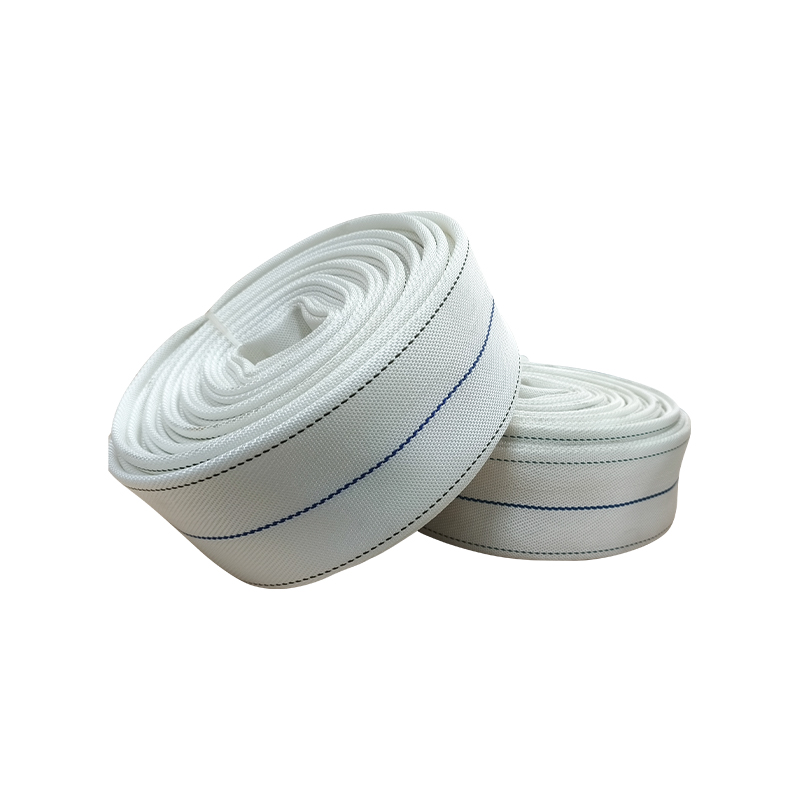
Operating practice also matters. Unroll the hose fully before opening the water valve, and never drag a pressurized hose over sharp edges. If a kink does form, slowly reduce pump pressure before bending the hose back into shape. For agricultural or mining applications where the hose is moved frequently, choosing a heavier-jacket hose with Storz couplings, such as our PVC-lined layflat hose for heavy-duty transfer, can significantly reduce kink-related downtime. Another option is to switch to a TPU-lined hose when kinking is persistent, since TPU returns to its original shape more readily after bending.
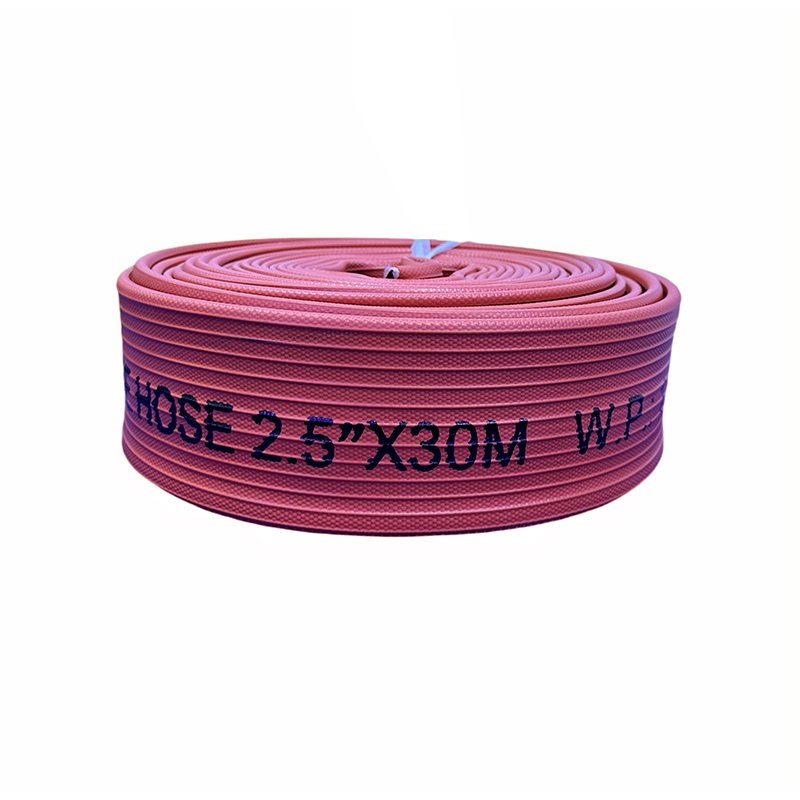
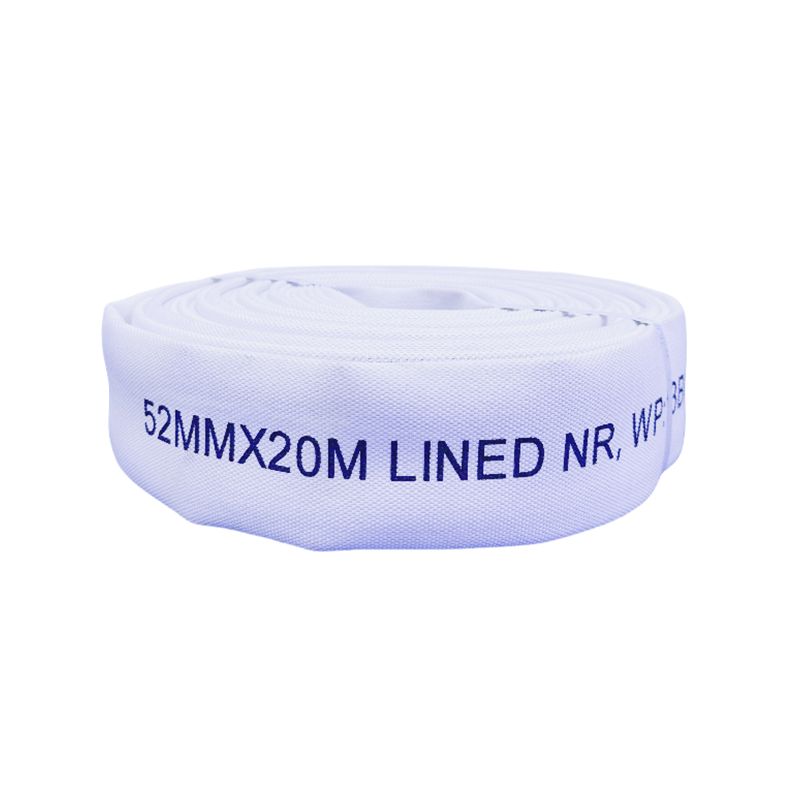 Wholesale Canvas Hose For Fire Extinguishing/Agricultural IrrigationTaizhou Jun'an Fire Technology Co., Ltd. Is China Wholesale Canvas Hose Suppliers, Exporter, Our Canvas Hose Is Mainly Used For Fire Figh...View Product →
Leaks at the Couplings and Fittings
Leaks rarely start in the middle of a PVC hose. They almost always develop at the junction where the hose attaches to a camlock, Storz, or other coupling. This is because the hose end is subjected to mechanical stress from tightening clamps, flexing during movement, and repeated connection and disconnection cycles.
Root Causes of Coupling Leaks
- Overtightening hose clamps, which deforms the PVC wall and causes the material to cold-flow away from the clamp.
- Using a clamp that is too narrow for the hose diameter, creating a concentrated stress line.
- Connecting a PVC hose to a coupling designed for a rubber hose with a different outer diameter tolerance.
- Failing to lubricate the hose end before insertion, which causes the PVC liner to tear on the barb.
Mining dewatering systems often face this problem because hoses connect and disconnect every shift. Our guide to mine dewatering hose connection methods describes how the installation procedure affects coupling retention. The key principle is that a coupling must be installed on a hose that is cut square and fully inserted into the fitting, with enough hose material beyond the clamp to support lateral force.
Solutions for Leak-Free Connections
- Cut the hose end square using a sharp knife or a chop saw before installation. Do not tear it by hand.
- Apply a thin film of soapy water or silicone spray to the inside of the hose end before inserting the coupling.
- Push the hose over the coupling shank until the hose wall meets the shoulder of the fitting.
- Use a double-bolt clamp or a band clamp with a width that matches the hose diameter. Never use a small hose clamp on a large diameter hose.
- For hoses over 3 inches in diameter, use a crimped or rolled grooved coupling rather than a screw clamp.
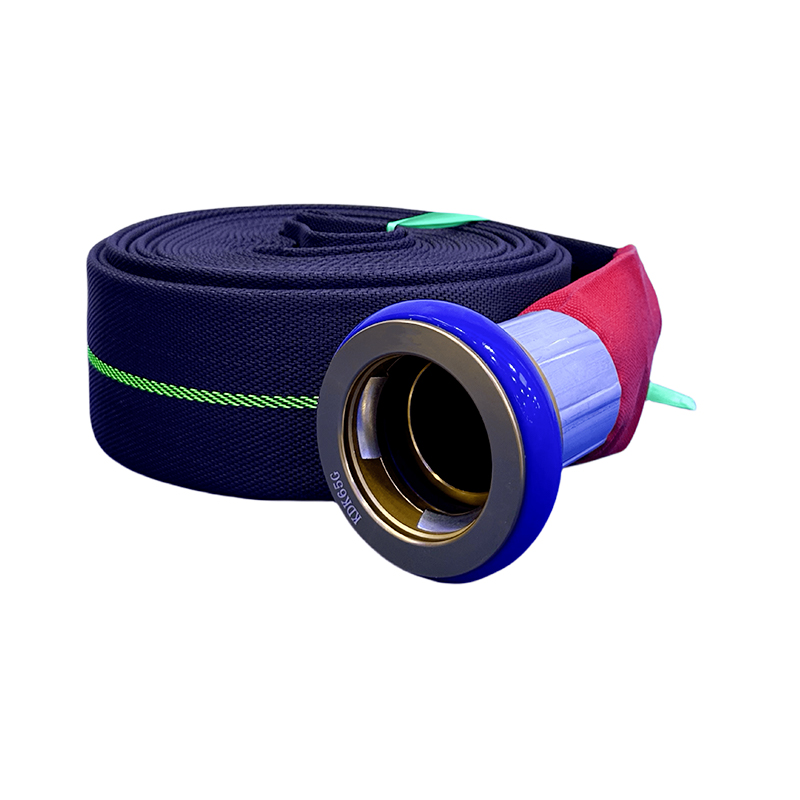
If you are using Storz couplings, which are common in firefighting and increasingly in mining, check that the gasket inside the coupling is intact and that the hose end is not bulged from previous overtightening. Pairing PVC hoses with matching Storz couplings from the same manufacturer reduces tolerance mismatch. This is why many of our 4-inch special mining dewatering hoses with Storz coupling are assembled in the factory under controlled conditions rather than in the field.
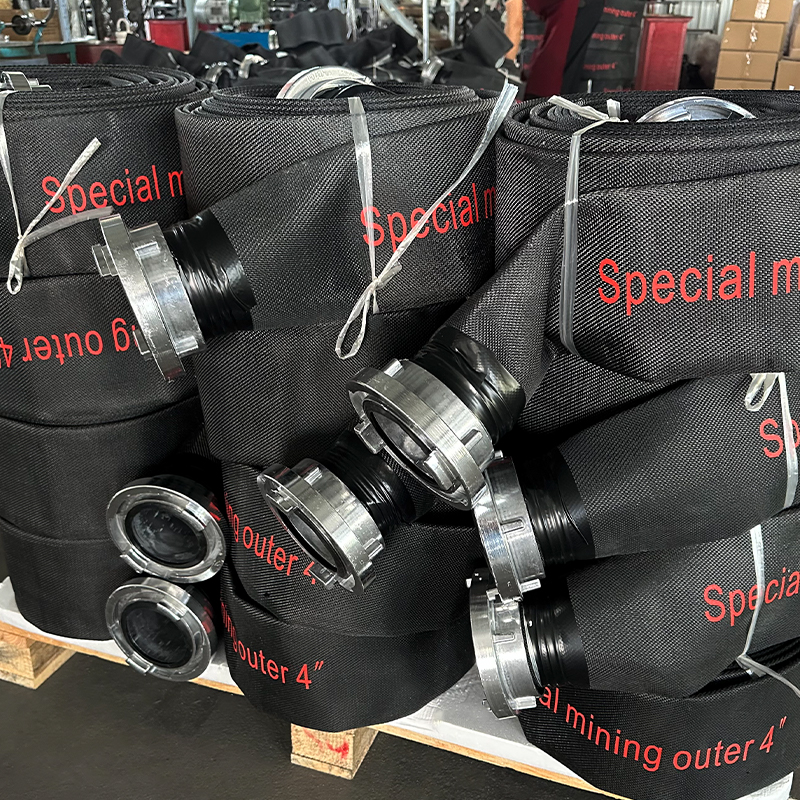 Wholesale 4Taizhou Jun an Fire Technology Co., Ltd Is Wholesale 4View Product →
Pressure Failure, Bursting, and Blowouts
Pressure-related failure is the most dangerous problem with PVC flat hose pipes. When a hose bursts, it releases a sudden spray of water at high velocity, which can injure operators or cause electrical hazards if the water reaches power lines. Understanding pressure ratings is therefore not just about performance; it is about safety.
| Hose Type | Working Pressure (bar) | Typical Use | Failure Risk |
|---|---|---|---|
| Light-duty PVC irrigation hose | 2–4 bar | Garden irrigation, light landscaping | Burst risk if connected to a pressure pump without an inline regulator |
| Standard PVC layflat hose | 6–10 bar | Agricultural water transfer, drainage, general construction | Blowout near couplings if reinforcement is weak |
| Heavy-duty PVC hose with woven polyester reinforcement | 12–16 bar | Mining dewatering, high-flow water supply, industrial transfer | Damage from external abrasion or extreme temperature exposure |
Pressure failure has a predictable sequence for PVC layflat hoses. First, the outer jacket thins at the point of maximum stress, usually near a coupling or a sharp bend. Then, the reinforcement layer begins to stretch and lose its dimensional stability. Finally, a pinhole or a longitudinal tear forms along the weak reinforcement path. Once a tear begins, it travels quickly along the hose length because fluid pressure continues to separate the broken fibers.
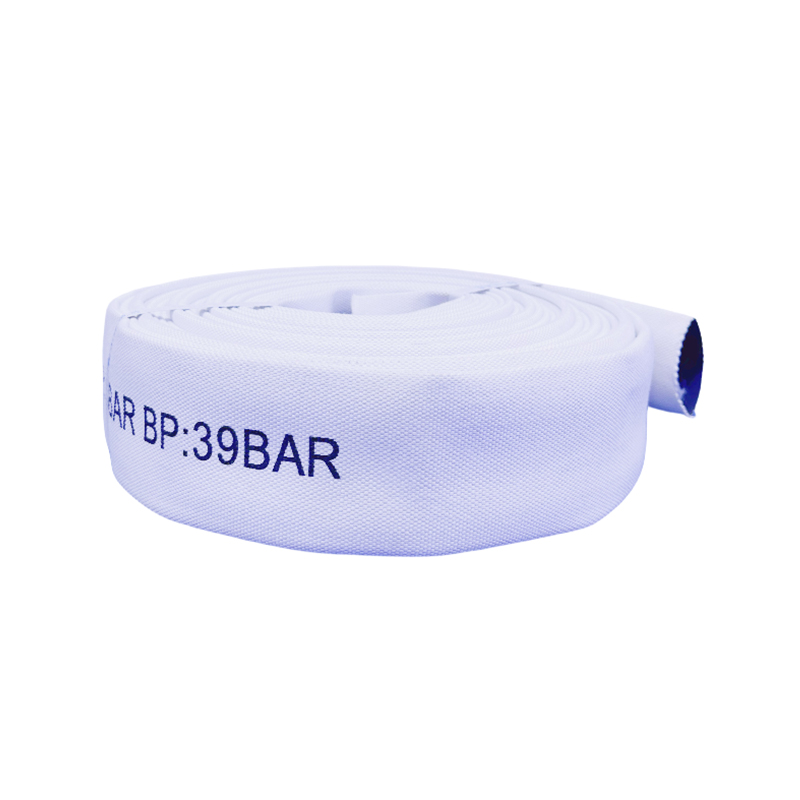
To prevent pressure failures, do not simply rely on the maximum rated pressure. Use the working pressure as the continuous operating limit and keep the burst pressure as a safety factor. For mine dewatering and heavy agricultural use, a 6-inch or 8-inch diameter hose requires careful matching between pump discharge pressure and hose rating. Our article on layflat hose pressure ratings and durability explains the margin you should keep between working pressure and tested burst pressure. Also, note that PVC hoses lose burst strength when exposed to water temperatures above 60 degrees Celsius. If your application involves hot water or chemical transfer, choose a hose designed for higher temperature resistance.
UV Damage and Outdoor Aging
PVC flat hoses are often stored outside on construction sites or farmyards. However, standard PVC formulations degrade under prolonged ultraviolet exposure. The sun breaks down the PVC polymers and causes the plasticizers, which keep the material flexible, to migrate to the surface or evaporate. The results are the classic signs of aging: a stiff surface, a white chalky film, and the development of small cracks.
How to Identify UV-Damaged PVC Hose
- Surface skin becomes rough and brittle rather than smooth and flexible.
- Deep bending causes surface cracks to extend into the reinforcement layer.
- Color fading is visible, especially for brightly colored hoses.
- A dust-like white residue appears after folding the hose, which is plasticizer leaving the material.
The solution starts with using a PVC formulation with UV stabilizers. Many hose manufacturers offer black or dark-colored hoses for outdoor use because darker colors resist UV degradation better than light colors. But you can also extend the life of any PVC hose by limiting exposure to direct sunlight when it is not in use. Roll it up, place it in a shaded shed, or cover it with a tarp.
For seasonal agricultural use, inspect the hose before each new season. Fold a section 90 degrees and look for white stress marks. If you see them, the hose is near the end of its service life and should be replaced. When UV exposure is unavoidable, consider switching the outer layer material. TPU hoses have naturally better UV resistance than PVC because the polyurethane polymer is inherently more stable in sunlight. Some fire departments and mining companies have standardized on TPU-lined hoses for this reason, even though the initial purchase cost is higher.
Cold Weather Cracking and Reduced Flexibility
PVC has a glass transition temperature around -20 degrees Celsius, depending on the plasticizer content. At temperatures below zero, PVC hoses become stiffer, more brittle, and less resistant to impacts. If you unroll a PVC hose in winter and sharply pull it over a sharp rock or a vehicle tire, the outer jacket can crack. Water left inside a cold PVC hose will also freeze. Expanding ice can crack the inner liner and create a permanent leak path even after the hose thaws.
Preventive Steps for Cold Weather Use
- Drain all water from the hose after every use and incline the rolled hose so residual water can run out.
- Store PVC hoses in a heated storage area when outdoor temperatures drop below 5 degrees Celsius.
- Do not bend the hose sharply when it is stiff. Let it warm up in a heated room before unrolling.
- For winter operations, select a TPU-based hose that maintains flexibility at -40 degrees Celsius.
Many mine sites and municipal fire departments that operate in cold regions use TPU flat hoses instead of PVC for this reason. A TPU hose can be unreeled and re-coiled at freezing temperatures without cracking, while a standard PVC hose becomes almost board-like. Our guide to TPU layflat hose cold temperature cracking resistance provides a more detailed analysis of this issue.
Abrasion and External Wear
PVC flat hoses run along the ground, and the ground is rarely smooth. Rock fragments, road shoulders, steel edges, and repeated dragging over concrete can wear through the protective outer jacket. Once the outer jacket is penetrated, the reinforcement layer is exposed. From there, abrasion quickly severs the polyester or nylon fibers, reducing the burst pressure dramatically.
This is particularly a problem in mining dewatering and construction dewatering, where the hose is laid across mine yards and rough terrain. The 6-inch and 8-inch hoses used in these applications are long and heavy, so they cannot be lifted off the ground after every shift. They are dragged, slid, and repositioned.
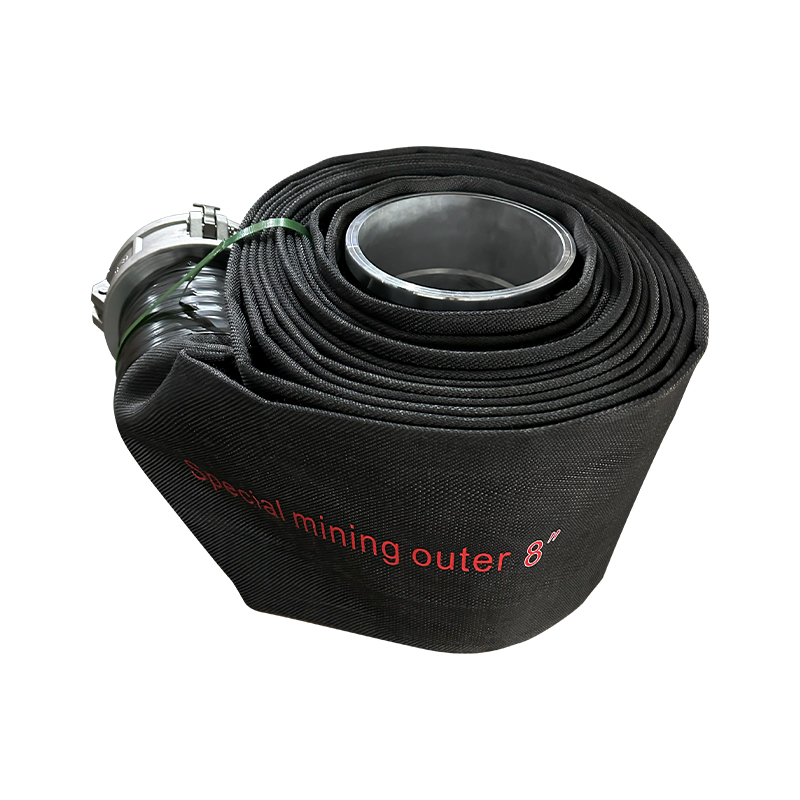
For high-abrasion environments, the solution is to choose a hose with an abrasion-resistant outer cover. Some specialty hoses have a thicker external rubber or TPU coating that acts as a sacrificial wear layer. For example, our 6-inch wear-resistant flat hose for mining-grade external dewatering is designed with this use case in mind.
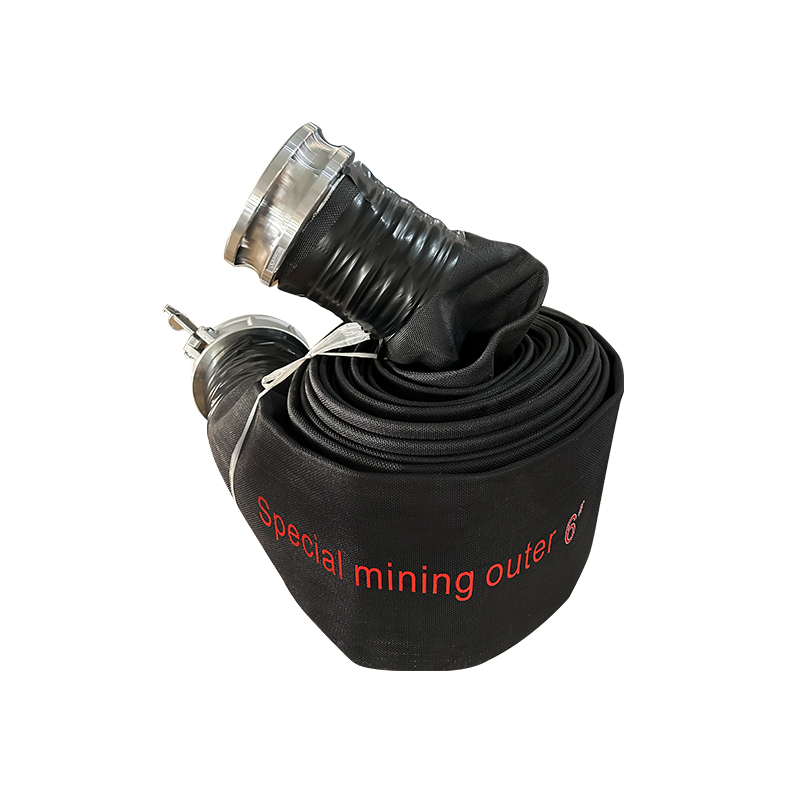 Wholesale 6-Inch Wear-Resistant Flat Hose With Storz Connector For Mining-Grade Taizhou Jun an Fire Technology Co., Ltd Is Wholesale 6-Inch Wear-Resistant Flat Hose With Storz Connector For Mining-Grade External Drain...View Product →
| Abrasion Location | Cause | Countermeasure |
|---|---|---|
| Bottom surface of the hose | Direct contact with gravel, rocks, or rough concrete | Use a hose with a thicker outer cover or place it on a protective mat |
| Near the coupling tail | Bending and dragging stresses concentrated at a short section | Add a flexible protective sleeve or use a longer hose to reduce movement |
| Where the hose crosses a road | Vehicle traffic frequently runs over the hose line | Use a hose ramp or install a pressure-relief crossing cover |
During regular maintenance, inspect these specific spots for signs of wear or fabric exposure. Catching abrasion damage early is far cheaper than replacing a hose that has blown out on site.
Chemical Degradation and Material Incompatibility
PVC is a polar polymer with particular resistance to water, acids, alkalis, and most salts. That is why it works well for water transfer, irrigation, and firefighting. But PVC is also attacked by strong solvents, aromatic hydrocarbons, gasoline, and certain oils. These chemicals cause the hose to swell, soften, and lose mechanical strength.
The real-world problem appears when a PVC hose is used for a chemical transfer task it was not designed for. Examples include transferring diesel to a pump, moving oil-contaminated wastewater, or using a PVC hose to spray agricultural chemicals dissolved in aromatic solvents. The hose may look fine on the outside while the inner liner is softening and blistering.
If your fluid chemistry is uncertain, the safest approach is to compare the chemical resistance of different hose liners. EPDM and TPU liners handle hydrocarbons and oils better than PVC. Always review the chemical resistance chart provided by the hose manufacturer for the specific concentration and temperature of the fluid you plan to transfer.
Bacterial and Algae Growth in Stored Hoses
Another less common but important problem is the formation of biofilm and algae inside the hose. This happens when water is left standing inside the hose after an agricultural or firefighting application, especially in warm weather. Algae growth reduces water quality, clogs downstream nozzles and sprinklers, and can produce a musty odor that is hard to remove.
The prevention is straightforward: completely drain the hose after every use and leave both ends open during storage so internal moisture can evaporate. If algae has already formed, flush the hose with a solution of dilute bleach and water, then rinse thoroughly. Never store PVC hoses in direct sunlight after chemical flushing; dry them in a shaded area.
Choosing the Right PVC Flat Hose Specifications
Many operational failures are not caused by mishandling but by selecting the wrong hose in the first place. The table below summarizes the key specifications to check before purchasing a PVC flat hose.
| Specification | What to Verify | Why It Matters |
|---|---|---|
| Rated working pressure | Pump discharge pressure must be below the rated working pressure. | Prevents premature burst failure and protects operators. |
| Hose diameter tolerance | Inner diameter must match the coupling and flow requirements. | Too small increases friction loss; too large reduces pressure rating. |
| Reinforcement material and density | Polyester or nylon weave density affects burst strength and kink resistance. | Weak reinforcement leads to blowouts and flattening in high-flow conditions. |
| UV stabilizer content | Check if the hose is formulated for continuous outdoor exposure. | Prevents jacket cracking and plasticizer loss over time. |
| End fitting compatibility | Confirm that the hose outer diameter matches your Storz, camlock, or other coupling size. | A mismatch creates leaks and safety hazards. |
Direct manufacturers like Taizhou Jun'an Fire Technology Co., Ltd. can provide a matching specification profile before you commit to a volume order. Checking these points early helps you avoid the most common problems with PVC flat hose pipes before they become emergency repairs.
Preventive Maintenance and Inspection Schedule
A simple inspection routine will catch most PVC flat hose problems while they are still easy to fix. Perform these checks before each use, after each use, and at least once per month during long storage periods.
- Before each use: Check for cracks, bulges, and scored areas on the outer jacket. Unroll the entire hose and look for pinholes that whistle under pressure.
- After each use: Drain water, remove mud and chemicals, and inspect the coupling area for clamp slippage or gasket wear.
- Monthly storage check: Re-roll the hose with a different fold position to prevent permanent set. Pressurize to half working pressure and verify there are no leaks.
By building these inspections into your operational routine, you can significantly prolong the service life of your PVC flat hose and reduce the risk of emergency downtime on your fire or dewatering site.